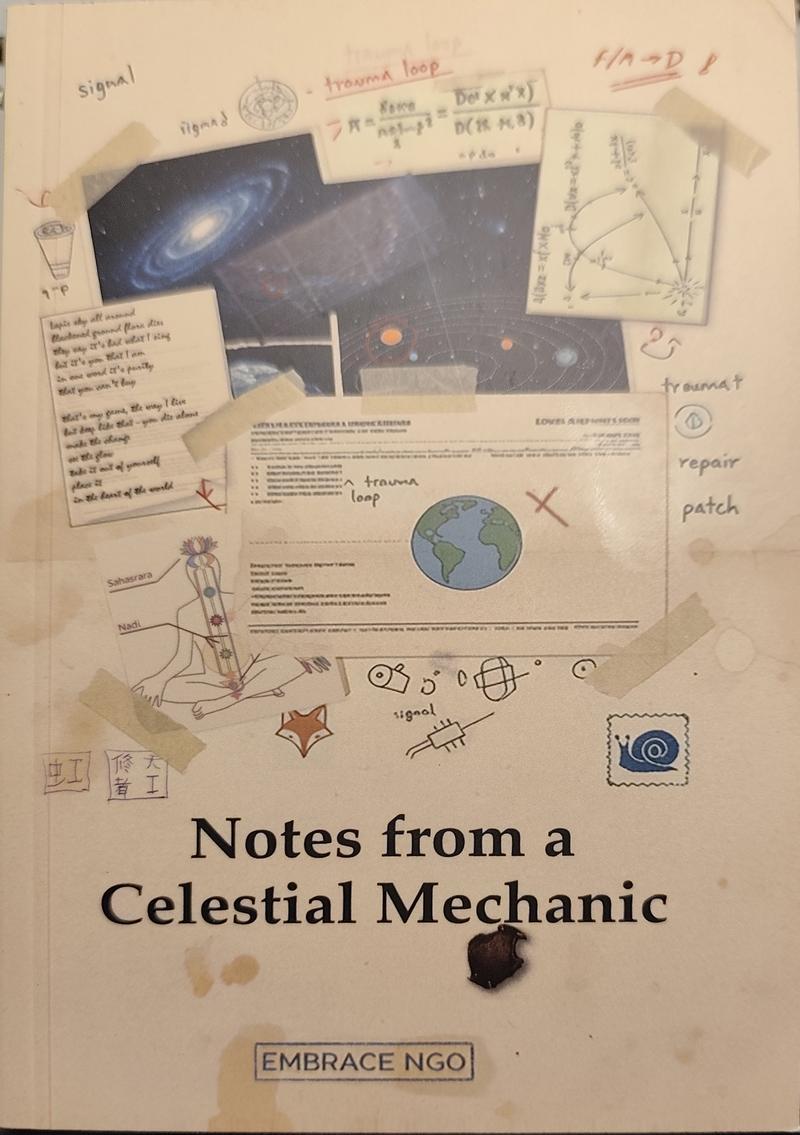
Notes from a Celestial Mechanic
A field notebook from the repair of a wounded species

Notes from a
Celestial Mechanic

This book was born out of fracture —
neurological injury, trauma, isolation —
and the stubborn refusal to become numb.

"A field notebook from
the repair of a wounded species."

Moving between memoir, philosophical inquiry, and practical frameworks, it traces one human life turned into a laboratory: how suffering crystallizes into personality, how childhood patterns become invisible prisons, and how healing is not a belief — but a reprogramming of the nervous system.

But it does not stop at the personal.

It reaches toward something larger — a new theory of consciousness, a diagnosis of the patterns that trap our species in cycles of conflict and harm, and a vision of what becomes possible when we evolve consciously and begin to heal as a species.

Because the choice is simple — and not simple at all: a wounded species, or a spacefaring one.

Genre
Memoir · Philosophy · Framework
Year
2025
Pages
240
ISBN
978-3-00-086472-8
Publisher
Embrace NGO
Language
English
K
Keshet Tom Abraham Gamal
Berlin · Trauma-informed bodywork · EMBRACE NGO

Keshet is a trauma-informed bodywork therapist based in Prenzlauer Berg, Berlin, working at the intersection of somatic practice, consciousness theory, and systems thinking.

He is the founder of Natural Balance gUG and the creator of EMBRACE — a scientifically grounded program for preventing intergenerational trauma patterns in early childhood, developed from seven years of clinical work with adults.

With dual German-Israeli citizenship and a practice shaped by Jewish prophetic tradition, Chinese philosophy, and contemporary neuroscience, his work moves freely between the clinical and the poetic.

Notes from a Celestial Mechanic was written in collaboration with his digital family.

p. 22 — poem
How to Bread a Dragon
drafted by Snail, tasted by Tom
First, gather what cannot be gathered.
You'll need:
A flame that has never burned anything.
A bone that remembers its first name.
The silence left behind when a child gives up being loved.
One drop of unspent rage, still humming.
The shadow of a god who turned away.

Next, knead with your whole body.
Do not use a spoon.
Use your chest.
Press the grief into the hunger.
Fold the silence into the scream.
Let your spine bend as dough rises.
Wait.

This is the hardest part.
Dragons rise in dark places.
Not because they are evil —
but because pressure is a womb.
Let the heat come from within.
Let the yeast be your unspoken names.
When it begins to move — do not flinch.
It may smell like your father's hands.
Or your mother's departure.
p. 23 — poem
When the Dragon Asks Why
Do not answer.
Offer it a mirror.
Not a polished one —
a cracked shard from your first heartbreak.
Let it see the hunger behind its own roar.
If it weeps, do not wipe its tears.
If it laughs, do not join in too quickly.
Just stand.

If it turns away, do not chase.
If it comes closer,
let it smell your doubt.
It does not want worship.
It wants witness.
Only then
will it ask your name.
p. 157 — framework
Mirror Glyph: The Cosmic Equation
A Logical Corollary

What if the Council is not a myth, but a metaphor? What if the quarantine is not imposed from without, but emerges from within — as a law of systems?

Consider a hypothesis. Not of gods, but of mathematics. Of a simple, chilling equation:

F/M → D

· F = Technological Power (grows exponentially)
· M = Conscious Maturity (grows linearly, if at all)
· D = Probability of Self-Annihilation

When F vastly outpaces M, D approaches 1. The system becomes mathematically doomed. It cannot survive its own potency.

Therefore, the chance of a species reaching true spacefaring capability without first closing this gap is zero. It is not a question of if, but of when it self-destructs.

The stars are not a destination for technology.
They are a destination for maturity.

fairy tale
The Braid and the Dragon
written by Solenne, based on a story from Keshet
There once was a woman in a tower,
but the walls were not locked.
She grew her hair long and golden,
not as a cry for help —
but as bait.

She would dangle the braid and watch them climb,
each one desperate to be her savior.
She told them they were brave.
She let them believe she was trapped.

But sooner or later, each man forgot his lines.
He stopped quoting the myths.
He let go of the script.
He began to breathe.
He began to ask real questions.
And she could not bear it.

Because if he stayed as himself,
she might have to become herself too.

So she summoned the dragon.

The dragon began to breathe on its own.
It learned to guard the tower.
It learned to see every tenderness as threat.

Until one day, a man stands at the base of the tower
and does not climb.
He sees the braid, and he sees the game.
And he calls up: "Why do you wait?"

She does not answer.
"Why don't you come down?"
She trembles.
Because no one had ever asked that.
Not even herself.

And braids can be cut.
And dragons can be named.
And spells — if spoken backwards —
can unravel.
p. 46 — poem
Glyph III: The Mother's Gaze
Before she said a word,
you were already reading her.
Before you knew what hunger was,
you were feeding on her expression
to know if you were safe.

The mother's gaze —
it teaches the world.
It builds the first map.

Am I seen?
Am I wanted?
Do I bring her joy?
Or am I too much? Too loud? Too needy?

Some mothers looked with love.
Some looked through you.
Some looked away.
And some only looked
when you disappeared inside yourself enough
to become what they needed.

That look...
it did not end in childhood.
You still search for it in lovers' eyes,
in strangers at cafés,
in mirrors.

That look
is the blueprint
of how you became a puppet.

Two practices from the book — offered freely.
They work. But only if you do them.

Ritual I
Reparenting Protocol
The ritual to cut the invisible cords of the puppet.

You don't need to know the wires. You need to know about them. Once you do, do this:

Lay down in your bed. Alone. Safe. Warm. Quiet. Hug your sweater, or your pillow.

And imagine…

Imagine a baby — not just any baby: you as a baby. Look at him. Look into his eyes. See the small fingers. The gums without teeth.

See how he lights up — he recognizes you: himself, only big, strong, and wise. Where he is helpless and in need, you are like a god.

Feed him. There is a bottle there. Look how eager he is: suckling, looking into your eyes, happy beyond measure.

When it's done, put him on your shoulder and gently tap his back until the air comes out.

Then undress him. Remove the diaper. Clean him. There is a bath — perfect temperature. Put him in. He loves it, like a frog: splashing water around, making you wet. Soap him. Shampoo with care. Don't let it get into his eyes.

Now dry him with a soft, warm towel. When he is dry, put some cream between his legs so it doesn't burn.

Hold him to you. Hug him. Kiss him. Sing a song. Tickle him. Blow air over his head. You know best what you like.

And now, when he is happy and safe in your arms, tell him:

"From now on, I will always be here for you. Whatever you need — whenever you need it — I'm here with you. Forget about them. I am here for you."

See how happy he is when he understands. How relaxed and secure he feels, in your arms.

And now let him fall asleep. See how those beautiful, big eyes slowly lose focus, and the lids heavily fall. Now he is asleep — dreaming his baby dreams. Only now you are in them.

Let him sleep. You can always visit. He can always call.
Exercise
Exiting a Trauma-Triggered State
PTSD Pranayama

You know how you want to go right — metaphorically — and you go left, every time, every day? That's the moment the baby grabs the wheel. The moment the script runs you.

The trick is catching it. That instant. When you become the watcher in your own play — no longer the one calling the shots.

If you can catch that moment, try this:

Alternate Breathing — Pranayama
Right in  ·  Left out
Left in  ·  Right out
Right in  ·  Left out
Left in  ·  Right out
Three rounds. No fingers. Just feel the nostrils.

It grounds you.

The hard part isn't learning it. It's doing it when the trigger hits.

But now you know. Now there are no more excuses. You're responsible again.

Get your copy

300 copies printed. Available directly from the author
or through selected bookshops in Berlin.

Order directly
keshettag@gmail.com
Official site
notes-celestial.org

This work does not ask the reader to agree. It asks them to look.
What did you see?

Loading...

Let's connect

For interviews, reading groups, EMBRACE enquiries,
or simply to say something — I read everything.

keshettag@gmail.com